

New publication on ACS Sustainable Resource Management. The article “From Watermelon Liquid Fraction Waste to Value: Modulation of Microalgal Lipid and EPS Profiles by Light and Carbon Sources” by Paolina Scarponi, Veronica D’Eusanio, Maria R. Cramarossa, Carla Sabia, Ramona Iseppi, Lorenzo Tassi, and Luca Forti involved different reseach groups from the Department of Life Sciences and the Department of Chemical and Geological Sciences of the University of Modena and Reggio Emilia.
ABSTRACT
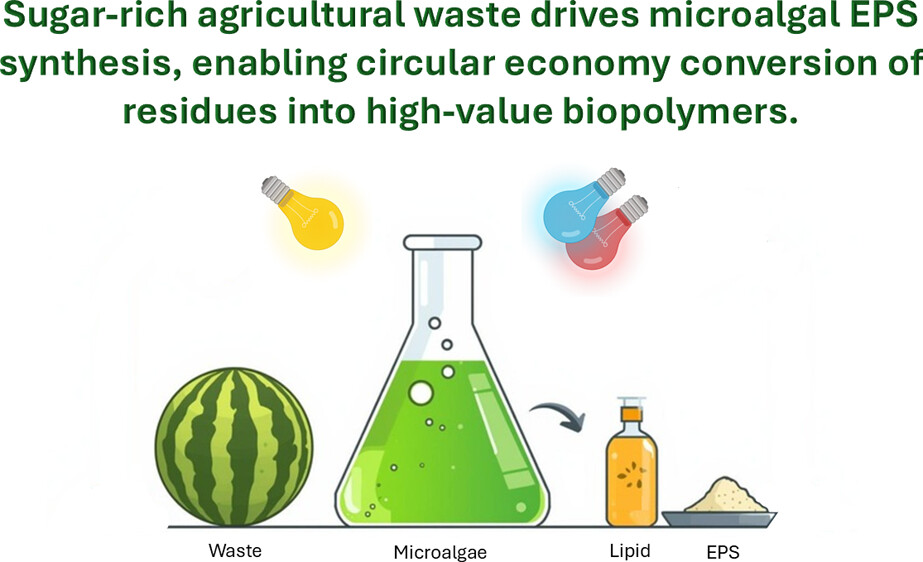
Watermelon cultivation generates substantial seasonal residues that are often discarded in fields, where their high sugar content may cause adverse environmental impacts. This study aimed to investigate the biotechnological valorization of watermelon liquid fraction waste (WLFW) within a circular economy framework by using it as a carbon-rich substrate for the cultivation of Chlorella vulgaris and Scenedesmus sp. under two light regimes: white light (WL) and red-blue light (RLBL). The effects of light quality on biomass production, lipid accumulation, and extracellular polysaccharide (EPS) synthesis were evaluated. Under RLBL irradiation, EPS yields reached 2.76 ± 0.36 g L−1 for Chlorella and 5.03 ± 0.37 g L−1 for Scenedesmus, representing up to a two-fold increase compared to WL conditions. GC-MS and FTIR analyses revealed distinct light-dependent variations in EPS composition, with RLBL promoting glucose enrichment in both strains. Lipid profiling indicated strain-specific responses: RLBL enhanced monounsaturated fatty acid synthesis in Scenedesmus and increased oleic acid accumulation in Chlorella. Overall, these findings demonstrate that light quality modulates EPS structure and composition, highlighting the potential of WLFW-fed microalgal cultures for applications in industrial and biotechnological sectors.
See the full text at: https://pubs.acs.org/doi/10.1021/acssusresmgt.5c00649